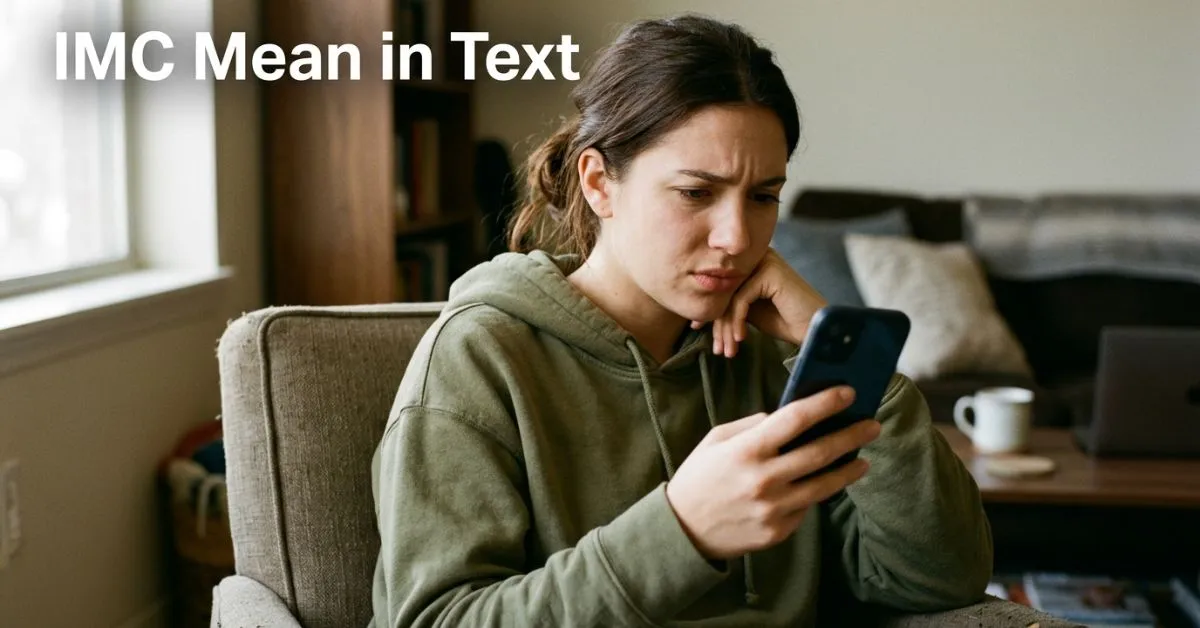
I still remember the first time I saw someone text me “IMC” in the middle of a serious conversation. I had shared a plan with a friend, and they replied with just: “imc about this tbh.”
At first, I stared at my phone thinking, what does IMC even mean? 😅 I thought maybe it was some random typo, but the conversation felt serious, so I knew it had to mean something important. I got curious and looked into it, and that’s when I found out IMC means “I’m Concerned.” It’s usually used when someone feels worried, uneasy, or thinks something about the situation doesn’t seem right.
Once I understood it, the whole message made sense my friend was basically saying they were worried about my plan and wanted me to think twice. If you’ve ever received IMC in a text and felt confused like I did, don’t worry — it’s actually a simple slang term once you know the context.
Quick Answer:
👉 IMC means “I’m Concerned” used in texting to express worry, doubt, hesitation, or unease about a situation, plan, or piece of news. It is used to signal that something isn’t sitting right and deserves more attention or care.
🧠 What Does IMC Mean in Text?
Let’s break down the full IMC meaning in text because this abbreviation does something emotionally specific that’s worth understanding properly.
IMC stands for “I’m Concerned.”
At its core, IMC communicates worry or unease. When someone types IMC, they’re signaling that something in the conversation has triggered a feeling of concern either about a plan, a situation, another person’s wellbeing, or an outcome they can see coming.
But like most emotionally loaded abbreviations, the INTENSITY of that concern varies significantly:
The Emotional Range of IMC:
1. Mild Concern / Gentle Skepticism The lightest version a soft eyebrow raise at something that doesn’t quite add up:
“you’re driving there in that weather?? imc a little 😬”
2. Genuine Worry About Someone When the concern is care based worried about a friend’s situation or choices:
“imc honestly, you’ve been exhausted all week and now you’re taking on more?”
3. Red Flag Detection When IMC signals that something about a situation feels off or potentially problematic:
“imc about how this whole thing is being handled 😒”
4. Playful Dramatic IMC Between close friends with a humor heavy dynamic, IMC can be used with exaggerated drama over something minor:
“you’re putting pineapple on your pizza?? imc 😭”
5. The Collective IMC When a group shares concern about a shared situation:
“imc about this whole plan ngl, something doesn’t feel right”
Secondary Meanings of IMC:
In different contexts, IMC can also stand for:
- Integrated Marketing Communications in marketing and business education contexts, this is actually the primary professional meaning. IMC as a marketing strategy involves coordinating all promotional tools to deliver a consistent message.
- In My Consideration occasionally used as a gentler, more formal cousin of “in my opinion” in some online discussion spaces.
- I Must Confess a less common but existing use where someone is about to admit something.
For everyday casual texting between friends and in social media spaces, the dominant meaning you’ll encounter is “I’m Concerned.”
Full Form: I’m Concerned (casual slang) / Integrated Marketing Communications (professional) Origin: Casual texting culture Category: Emotional expression / concern signal Tone: Worried, cautious, sometimes playfully dramatic
Example sentence:
“imc about the decisions being made here frfr 😬 someone needs to say something”
💡 Summary: IMC = I’m Concerned = A texting abbreviation that signals worry, unease, or skepticism about a situation ranging from light hearted dramatic concern to genuine heartfelt worry about someone or something.
📱 Where Is IMC Used?
The IMC meaning in text appears across different digital platforms, particularly in spaces where people share opinions and react to situations. Here’s the full breakdown:
- iMessage / Regular Texting 💬 The most intimate home for IMC in its “I’m Concerned” meaning. Between close friends discussing plans, life situations, or concerning news, “imc” flows naturally as a quick signal that something isn’t sitting right. It’s the kind of abbreviation you use with people who know you well enough to understand the emotional register.
- WhatsApp 💬 Group chats use IMC when someone shares news or a plan that triggers collective concern. One on one conversations use it when a friend says something that raises a worry. “Imc about this tbh, has anyone else thought it through?” is a very standard WhatsApp group message.
- Snapchat 👻 Quick snap chat reactions to stories or news. When someone shares something questionable and you want to signal concern without writing a paragraph, “imc 😬” does the work efficiently in the Snapchat format.
- Twitter / X 🐦 IMC appears in reactions to news, announcements, and situations that generate public concern. “Imc about how this is developing 😬” as a tweet reaction to unfolding events is completely natural in Twitter’s commentary culture.
- Instagram DMs 📩 Used in DM conversations when reacting to something a friend shared a situation, a decision, a post from someone else that triggers genuine or playful concern.
- TikTok 🎵 Comment sections use IMC when reacting to videos that show concerning behavior, questionable decisions, or situations that don’t seem right. “Imc about this honestly 😬” in a comment thread is completely standard.
- Discord / Gaming Chats 🎮 In gaming communities and interest based Discord servers, IMC appears when someone shares a plan, strategy, or real life situation that raises concern among the group. Also used in the marketing/business meaning in professional Discord communities.
Formality Check:
| Type | Fits IMC (I’m Concerned)? |
| Casual (close friends, social media) | ✅ Natural and appropriate |
| Semi formal (online communities, acquaintances) | ⚠️ Fine if context makes meaning clear |
| Formal (work, academic) | ❌ Use “I have concerns about” or “I’m concerned that” |
💬 Real Conversation Examples
Here’s the IMC meaning in text playing out across real digital scenarios feel how the concern level shifts across different contexts:
Example 1 The Gentle Worry
Mia: I’ve been sleeping like 4 hours a night this whole week Jake: imc honestly 😬 that’s not sustainable Mia: I know I know, just so much going on Jake: imc though frl, you need to sleep 🙏
Example 2 The Plan Red Flag
Sam: so the plan is to drive six hours, get there at 2 AM, and then start the hike at 6 AM Dev: imc. 😬 Sam: what? it’s fine, we’ll sleep in the car Dev: imc is the understatement of the year tbh
Example 3 The Group Chat Concern
Group Chat: Tia: did anyone look at the actual details of this trip Bree: imc now that I’m looking at it 😬 Marcus: same, imc about the timeline specifically Dev: glad it’s not just me, imc about multiple things
Example 4 The Playful Dramatic IMC
Jordan: I’m about to eat cereal with water because we’re out of milk Riley: imc 😭 please don’t do this Jordan: it’s fine it’s basically the same Riley: imc MORE now 💀
Example 5 The Relationship Situation
Bex: he said he’d text me back “sometime this week” when I asked when we’re hanging out Leah: imc about that phrasing honestly 😬 Bex: right?? it’s weird Leah: imc frfr, “sometime this week” is not a plan
Example 6 The Public Situation Reaction
Twitter/X: Tweet about a confusing public decision Reply: imc about where this is heading 😬 Reply: same, imc has been activated Reply: imc and I don’t know how to turn it off 😭
Example 7 The Genuine Care
Alex: I keep putting off the doctor’s appointment because I’m scared of what they might find Chris: imc about you, that’s exactly when you need to go 🥺 Alex: I know you’re right Chris: imc and I want you to be okay 🙏
Example 8 The Strategy Concern (Gaming)
Player1: okay my plan is to go solo into the final zone Player2: imc about this strategy 😬 Player1: trust me Player2: imc strongly but okay 💀
🕓 When to Use and When NOT to Use IMC
Here’s your complete practical guide to using IMC in text correctly when it communicates care and when it might miss the mark:
✅ When to Use IMC:
- When something genuinely worries you about a friend’s situation, plan, or wellbeing
- Reacting to questionable plans or decisions that seem risky
- Gentle red flag flagging when something doesn’t feel right
- Playful drama with close friends about minor things in a humor forward way
- Group chat check ins when multiple people share the same unease
- Social media commentary on concerning news or situations
- Checking in on someone who’s been going through something hard
❌ When NOT to Use IMC:
- Professional work emails “imc about this project direction” is too casual for formal communication
- Academic writing wrong register entirely
- When someone needs full emotional support a lone “imc” to someone in crisis can feel insufficient; pair it with more words
- With people unfamiliar with the abbreviation they might confuse it with the marketing meaning
- When your concern is very serious for truly heavy situations, spell out “I’m really concerned about you” to communicate the full weight
📊 Context Comparison Table:
| Context | Example | Why It Works (or Doesn’t) |
| Friend text | “imc about this plan 😬 let’s think it through” | Casual, caring, appropriately flagging concern |
| Group chat | “imc about the timeline honestly” | Collective concern, fits the group dynamic |
| Social media comment | “imc about where this is heading 😒” | Commentary culture, platform appropriate |
| Work Slack/email | ❌ “imc about this Q3 strategy” | Use “I have some concerns about” professionally |
| Crisis support | ⚠️ “imc” alone | Too brief pair with full words and genuine presence |
| Academic paper | ❌ “researchers were imc about the results” | Completely wrong register |
🔄 Similar Slang Words or Alternatives
If IMC in text is in your vocabulary, these related concern and caution expressions live in the same emotional space:
| Slang/Expression | Meaning | When to Use |
| Sus | Suspicious something seems off | When IMC is specifically about something seeming untrustworthy |
| Red flag | Warning sign in behavior or situation | When the concern is specifically about a pattern or signal |
| Lowkey worried | Subtly concerned without wanting to alarm | Softer version of IMC for lighter concerns |
| Not sure about this | Gentle skepticism or hesitation | Spelled out alternative when IMC might not be recognized |
| Side eye | Subtle skepticism or concern | More visual/humorous version of concern expression |
| This ain’t it | This is wrong/concerning/not right | When IMC meets clear judgment that something is off |
| Bruh | Exasperated disbelief (can signal concern) | When concern tips into bewilderment |
| Yikes | Concerned reaction to something cringe or worrying | When IMC needs a more expressive single word alternative |
The closest emotional equivalent to IMC is probably “lowkey worried” both signal concern without alarm, and both leave room for the conversation to continue productively. The key difference is that IMC is more efficient (three letters vs. two words) while “lowkey worried” is more self disclosing and slightly more vulnerable in tone.
FAQs❓
1. What does IMC mean in texting?
IMC stands for “I’m Concerned” in casual texting used to express worry, unease, or skepticism about a situation, plan, or someone’s wellbeing. It signals that something has triggered a feeling of concern that deserves acknowledgment or attention.
2. Is IMC rude or polite?
IMC is generally caring rather than rude it signals that you’re paying attention and something worries you. However, if used dismissively or frequently as a way to shut down someone’s ideas, it can feel critical. The tone depends entirely on the relationship and the surrounding conversation.
3. Can IMC mean something else in professional contexts?
Yes in marketing and business education, IMC stands for Integrated Marketing Communications a strategy that coordinates all promotional messages across channels for consistency. This is the dominant professional meaning of the abbreviation, completely separate from the casual texting meaning.
4. Who uses IMC as “I’m Concerned” the most?
Gen Z and younger millennials who are heavy texters and active on social media particularly in spaces where people share plans, situations, and news and invite reactions from their community. It’s especially common among friend groups with a slightly dramatic, humor forward communication style.
5. Can I use IMC in professional settings?
Not in its slang form. In professional communication, express concern explicitly: “I have some concerns about this approach,” “I’m concerned about the timeline,” or “I’d like to discuss some reservations I have.” The abbreviation IMC in professional contexts will either be confused with Integrated Marketing Communications or read as too informal.
6. Is IMC always negative?
Concern itself isn’t inherently negative it often signals care and attentiveness. “Imc about you” coming from a friend means they’re paying attention and care about your wellbeing. The feeling of concern is uncomfortable, but expressing it can be an act of genuine care. IMC is negative in the sense of flagging a problem, positive in the sense of demonstrating investment.
7. How should I respond if someone texts me IMC?
Take it seriously but calmly. If someone says “imc about [situation],” they’re inviting a conversation. Respond by acknowledging their concern and either addressing it (“here’s why I think it’ll be okay”) or validating it (“I know, I have the same feeling”). Don’t dismiss an “imc” it’s someone paying attention.
8. What’s the difference between IMC and “sus”?
Both signal something is off, but from different angles. Sus (suspicious) implies distrust something or someone seems shady or dishonest. IMC (I’m Concerned) is more broadly emotional it can be about risk, safety, someone’s wellbeing, or just a feeling that something could go wrong. Sus points outward; IMC can point at situations, plans, or people you care about.
Conclusion
If IMC in text had you puzzled If you received it and weren’t sure how to read it, or you wanted to know when and how to use it yourself you now have the complete picture.
Here’s the final recap:
🔥 IMC = I’m Concerned = A texting abbreviation that signals worry, unease, hesitation, or skepticism ranging from playful dramatic concern between friends to genuine heartfelt worry about someone’s wellbeing or safety, delivered efficiently in three letters that carry real emotional weight.
What makes IMC valuable in the texting vocabulary is that it names a specific emotional state that often gets lost in casual digital communication. In a world where “I’m fine” and “lol” cover a lot of emotional ground, IMC is specific. It says: something about this is registering as a problem for me, and I want you to know that.
That specificity is useful. It opens conversations. It shows attentiveness. This demonstrates that you’re actually reading what someone shares and responding to it thoughtfully rather than just sending a thumbs up.
Use it when something genuinely concerns you. Choose it with close friends who understand your communication style. Use it playfully when the vibe supports it. Use it seriously when someone needs to know you’re paying attention.
Just keep it out of formal work communication and save your most serious concerns for full sentences that carry the full weight of what you mean.
Because when someone really needs to hear “I’m concerned about you” two words deserve to show up fully, not abbreviated. 💅✨
Discover More Articles:
- What Does BTW Mean in Text : Your Complete Guide💬(2026)
- OM Mean in Text : Real Meaning Explained💬(2026)
- What Does PFP Mean in Text : Guide with Real Examples💬(2026)

I’m Jane Austen, the author of themeaning.com, and I’m an expert in meanings. I share clear explanations of words, phrases, and slang to help you understand them easily.