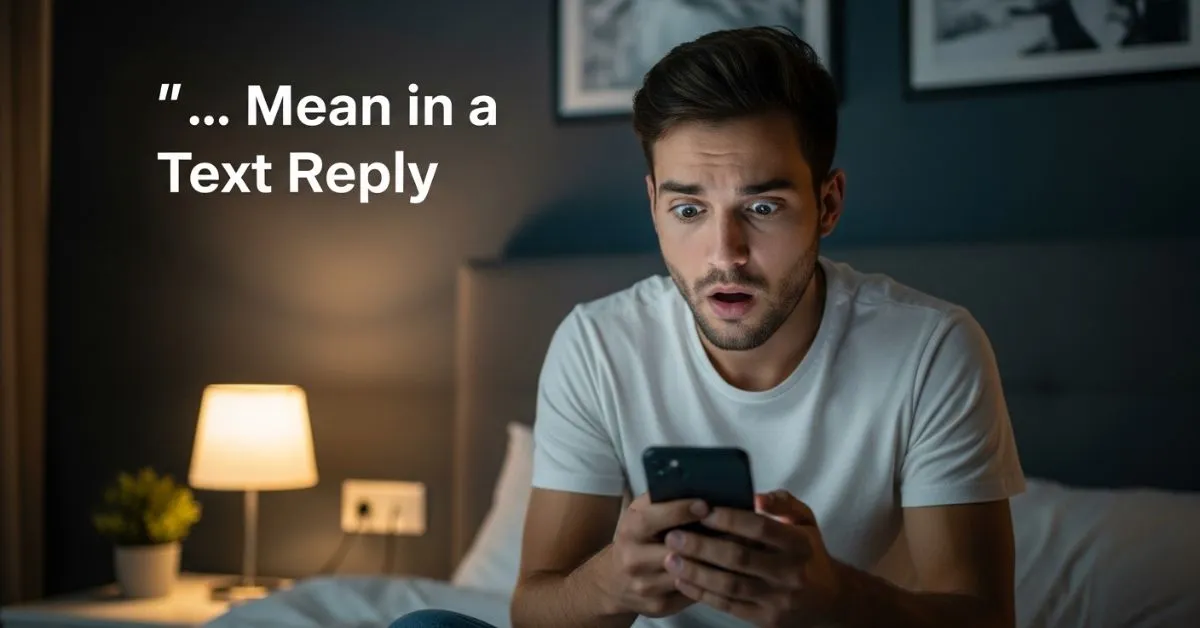
I still remember the first time someone replied to my message with just “…” and honestly… I panicked a little 😅 I had sent what I thought was a completely normal text. It was something simple like:
“Hey, are we still meeting tonight?”
And instead of getting a normal reply, they sent back:
“…”
That was it. No explanation. No words. Just three tiny dots staring back at me from my phone screen.
I instantly started overthinking everything.
Were they mad at me?
Did I say something wrong?
Were they confused?
Were they being sarcastic?
Or were they just trying to be dramatic? 😭
I even showed the message to my friend and asked, “Why would someone reply with dots only?”
My friend laughed and said, “Relax… it usually means they’re speechless, annoyed, awkward, disappointed, or they just don’t know what to say.”
That actually made sense because later I realized the meaning depends completely on the conversation.
Sometimes “…” can mean awkward silence.
Sometimes it shows frustration.
Sometimes it means “I’m judging you right now.”
And sometimes people use it for dramatic effect in funny conversations.
If you searched “what does … mean in a text reply,” you’re probably confused just like I was. Don’t worry I’ll break down all the meanings so next time someone sends you “…”, you won’t immediately assume your life is over 😂
Quick Answer:
👉 “…” in a text reply means silence, hesitation, or an unspoken reaction. It is used in texting to express speechlessness, awkwardness, disapproval, deep thought, or dramatic pause without using any actual words.
🧠 What Does “…” Mean in a Text Reply?
Let’s unpack this properly because “…” is genuinely one of the most layered symbols in texting culture.
The “…” symbol is called an ellipsis three consecutive dots that, in formal writing, indicate an omission or a trailing thought. But in texting? It has evolved into something much more emotionally charged and socially complex.
When someone sends you just “…” as a reply, they’re essentially communicating something they either can’t or won’t put into words. The ellipsis becomes a stand-in for an emotion, a reaction, or a judgment that the sender wants you to feel without them spelling it out.
Here are the most common meanings behind “…” in a text reply:
1. Speechlessness They literally don’t know what to say. Your message left them stunned, shocked, or overwhelmed.
2. Disapproval or judgment They think what you said (or did) was questionable, and the “…” is their silent side-eye. 👀
3. Awkwardness The conversation went somewhere uncomfortable and they don’t know how to respond.
4. Sarcasm or dry humor Among close friends, “…” can signal a “really?? that’s what you’re going with?” energy.
5. Thinking or processing They’re genuinely still formulating a response and sending “…” as a placeholder.
6. Dramatic pause They’re building suspense before dropping something big.
Example sentence:
You: “okay so I may have accidentally told your ex you still have feelings for them” Them: “…”
Yeah. That “…” is doing a LOT of work right there. 😅
💡 Summary:
👉 “…” = Ellipsis = an unspoken reaction that signals silence, hesitation, judgment, awkwardness, or disbelief in a text reply
📱 Where Is “…” Used?
The “…” reply isn’t platform-specific it travels freely across every texting and social media space because it requires zero effort to type and communicates maximum emotional ambiguity. Here’s where you’ll see it most:
- iMessage & SMS 💬 the most natural home for the ellipsis reply; it hits different in a blue or green bubble with zero other context
- Snapchat 👻 sometimes sent as a chat reply when someone’s story or snap leaves a person completely speechless
- Instagram DMs 📩 used in response to dramatic reveals, surprising confessions, or questionable decisions shared in DMs
- WhatsApp 💬 very common in personal chats and group messages when someone says something that stops the conversation cold
- Twitter/X used as a quote-tweet or reply to signal disbelief or silent judgment without engaging further
- TikTok 🎵 appears in comments under videos that are cringeworthy, shocking, or deeply awkward
- Discord 🎮 used in server chats or DMs when someone says something that the group collectively doesn’t know how to respond to
- Facebook Messenger older users use it too, especially in response to surprising family news or dramatic posts 😂
Usage style breakdown:
“…” is almost exclusively casual in the texting sense. In formal writing, ellipses have rules and specific grammar functions. But in texting, those rules go right out the window.
The tone of a “…” reply ranges wildly:
- Passive-aggressive: the most common interpretation in relationship or conflict contexts
- Playfully dry: between close friends who communicate in sarcasm
- Genuinely stunned: when the news is too big for words
- Ominously silent: when someone is upset and choosing silence over confrontation
It is never used in professional or formal contexts or at least, it shouldn’t be.
💬 Real Conversation Examples
Let’s look at how “…” shows up as a text reply across a range of real, relatable situations. These are the kinds of exchanges happening on phones everywhere:
Example 1 The Confession Backfire
A: “okay don’t be mad but I told mom about your secret boyfriend” B: “…” A: “I’m so sorry I panicked 😭”
Example 2 The Questionable Decision
A: “so I quit my job today without having another one lined up” B: “…” A: “say something please” B: “I genuinely don’t know where to start”
Example 3 The Dramatic Pause (Funny)
A: “guess who I just ran into at Starbucks” B: “who??” A: “…” B: “TELL ME RIGHT NOW I CANNOT”
Example 4 The Awkward Overshare
A: “I think I’m in love with my best friend’s boyfriend” B: “…” B: “okay so we need to talk about this”
Example 5 Dry Humor Between Friends
A: “I stayed up until 4am watching conspiracy theory videos and now I think the moon is fake” B: “…” A: “hear me out though” B: “absolutely not”
Example 6 The Silent Disapproval
A: “I texted my ex at 2am again” B: “…” A: “I know I know I know” B: “do you though”
Example 7 Genuine Shock
A: “they offered me the job and I start Monday and it pays double what I make now” B: “…” B: “WAIT” B: “WHAT” B: “I’m crying”
Example 8 The TikTok Comment Version
[Video of someone doing something incredibly awkward] Comment: “…” Reply: “the … says everything 😭”
⏰ When to Use and When NOT to Use “…”
Understanding what does “…” mean in a text reply is one thing knowing when to actually send it yourself is a whole other skill.
✅ When to Use “…”:
- When you’re genuinely at a loss for words after a shocking message
- When you want to communicate dry, silent judgment to a close friend without starting a fight
- When you’re being playfully dramatic to build suspense in a fun conversation
- When a friend says something so out-of-pocket that only silence can respond
- When you’re processing something big and need a second before you type a real reply
- When used humorously between people who know each other’s communication style well
- In TikTok comments or Twitter replies to signal collective speechlessness about content
❌ When NOT to Use “…”:
- In professional emails or work messages it reads as passive-aggressive or incomplete
- During serious, emotionally charged conversations where clarity matters more than silence
- When the other person is already anxious or upset a “…” reply can escalate their anxiety fast
- As a response to someone sharing mental health struggles or serious news they need words, not dots
- In first conversations with someone new it can come across as cold, confusing, or rude
- In customer service or business communication it looks unprofessional and careless
- When you actually want to say something don’t hide behind dots, just communicate
📊 Context Comparison Table:
| Context | Example | Why It Works (or Doesn’t) |
| Best friend chat | “…” after they admit a bad decision | Works perfectly silent judgment they’ll understand |
| Couple texting | “…” after a small argument | ⚠️ Risky can feel dismissive or cold |
| TikTok comment | “…” on a cringeworthy video | Totally native, widely understood humor |
| Group chat reaction | “…” when someone drops wild news | Great signals shared speechlessness |
| Work Slack message | “…” in reply to a colleague | ❌ Looks passive-aggressive or unprofessional |
| Email to a client | “…” as a response | ❌ Never use complete sentences always |
| Talking to someone in crisis | “…” when they share something serious | ❌ Harmful they need real words and support |
The key takeaway: “…” thrives in relationships and contexts where both people already understand each other’s tone. The moment there’s any ambiguity about the relationship or the mood reach for actual words instead. 💬
🔄 Similar Slang Words and Alternatives
“…” belongs to a whole family of minimalist, emotionally loaded text replies. Here are the closest alternatives and what sets each one apart:
| Slang/Symbol | Meaning | When to Use |
| “.” (single period) | Cold, clipped, or serious end to a statement | When you want to sound firm, final, or slightly ominous |
| “k” | Short for “okay” often passive-aggressive | When you’re annoyed but don’t want to argue |
| “lol” (dry) | Not actually laughing signals discomfort or awkward deflection | When something is uncomfortable but you’re brushing it off |
| 💀 (skull emoji) | “I’m dead” something is so funny or shocking it’s killing them | Reacting to something wild or hilarious |
| 👀 (eyes emoji) | Watching, noticing, or silently judging | When you see something interesting without commenting verbally |
| “okay.” | The period makes it passive-aggressive vs. casual “okay” | Signaling mild upset or finality without saying more |
| “noted” | Cold acknowledgment often signals dismissal or irritation | When you hear something but don’t want to engage further |
| “sure” | Can mean genuine agreement or sarcastic resignation | Depends entirely on context and tone |
| 🙂 (slightly smiling face) | Deceptively calm often signals suppressed frustration | When someone is NOT fine but wants you to think they are |
The common thread across all of these? They’re all examples of saying a lot by saying almost nothing. In modern texting culture, minimalism often carries the most emotional weight. The shorter and simpler the reply, the more the reader is left to interpret and that interpretation does all the heavy lifting. 🏋️
FAQs ❓
1. What does “…” mean in a text reply?
The “…” reply also called an ellipsis signals speechlessness, hesitation, silent judgment, awkwardness, or disbelief. It’s a way of reacting to something without putting that reaction into words. The exact meaning always depends on the context and the relationship.
2. Is sending “…” rude or polite?
It can be either, honestly. Between close friends it’s often funny or playfully dramatic. But in a serious conversation, a “…” reply can feel dismissive, cold, or passive-aggressive. Context is everything the same three dots can read completely differently depending on the situation.
3. Should I be worried if someone sends me “…”?
Not necessarily but it does signal that your message landed with impact. They either don’t know how to respond, they’re processing something big, or they’re holding back a reaction. If you’re unsure what they mean, the best move is to just ask: “what does that mean lol” or “okay, say what you’re thinking.”
4. Can I use “…” in a work chat?
Generally, no. In professional settings, an ellipsis reply reads as passive-aggressive, incomplete, or just plain confusing. If you need to signal that you’re thinking or that you’ll respond later, write it out: “Let me think about this and get back to you.”
5. Why do people send “…” instead of just saying what they mean?
Sometimes the feeling is too big, too complicated, or too loaded to put into words quickly. The “…” buys time and communicates that something was felt without committing to what that something is. It’s emotional shorthand that says “I have a reaction, I’m just not ready to share it yet.”
6. Is “…” the same as the typing indicator (three animated dots)?
No and this is actually a really important distinction! The animated three dots you see in iMessage or WhatsApp mean the other person is currently typing. But when someone actually sends just “…” as a message, that’s intentional they chose to send dots as their reply instead of words.
7. Who uses the “…” reply most?
Everyone uses it but it’s particularly common among Gen Z and millennials who have developed a rich vocabulary of minimalist, emotionally layered text responses. It also shows up heavily in online comment culture on platforms like TikTok and Twitter.
8. What’s the best way to respond when someone sends me “…”?
The best response is usually something light and direct like “lol okay say what you’re actually thinking” or “I know, I know 😭.” Don’t overthink it too much. If the relationship is solid, you can usually tell pretty quickly whether it’s playful or genuinely tense.
🎉 Conclusion
So there you have it the full breakdown of what “…” means in a text reply, from speechless shock to silent judgment to playful dramatic tension.
To recap: “…” as a text reply is one of the most emotionally loaded and context-dependent symbols in all of digital communication. It can be funny, it can be ominous, it can be deeply relatable and it almost always means the sender has feelings they haven’t fully expressed yet.
Use it wisely. Send it to people who know your communication style well enough to read between the dots. And in moments that call for real, clear, kind communication skip the ellipsis and just say what you mean. Your words matter more than you think. 💙
Now go check your texts and if someone just sent you “…” out of nowhere, you’ve got all the tools you need to decode it. 😄
Discover More Articles:
- LCL Meaning in Text : Real Meaning & Examples Explained💬(2026)
- What Does FTW Mean in Text : A Complete Guide💬(2026)
- MYF Mean in Text : The Friendly Slang Explained🤔(2026)

I’m Janet Frame, the author of themeaning.com, and I’m an expert in meanings. I uncover the true sense of words, phrases, and slang so you can understand them easily.