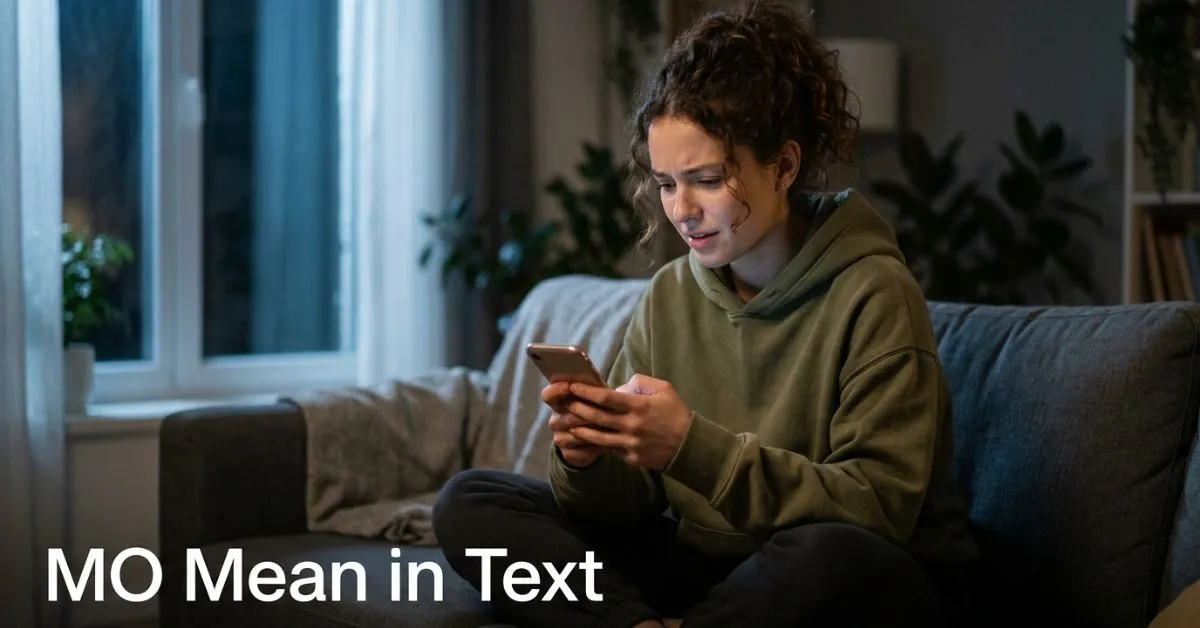
I still remember the first time I saw “MO” in a text message 😭 One of my friends replied to a group chat and said: “bro disappearing for days is literally his MO 💀” And I just sat there staring at my phone like… wait, what does “MO” even mean? At first, I thought it was some random typo or maybe short for a name 😅
So of course, I did what everyone does I opened another tab and started searching. That’s when I found out “MO” usually means “Modus Operandi,” which is basically someone’s usual way of doing things or their typical behavior. Suddenly the whole message made sense. My friend was joking that disappearing without replying was just that person’s normal habit 😂
After that, I started noticing “MO” everywhere in TikTok comments, Twitter posts, memes, and even casual texting. Sometimes people also use it to mean “moment,” depending on the conversation, which honestly confused me again for a while 💀
But once I understood the context clues, it became super easy to tell which meaning people were using. Now whenever I see “MO” in text, I instantly know If someone is talking about a person’s usual behavior or just referring to a specific moment online 😎
Quick Answer:
👉 MO means “Modus Operandi” a Latin phrase meaning someone’s characteristic way of doing things, their method, their style, or their typical pattern of behavior. It is used in texting to describe how someone typically operates or what their usual approach to something is.
🧠 What Does MO Mean in Text?
Let’s get into the full breakdown of the MO meaning in text because this one has a fascinating origin that spans from Latin to law enforcement to everyday casual conversation.
MO stands for “Modus Operandi.”
“Modus Operandi” is a Latin phrase that literally translates to “method of operating” or “way of working.” In its most formal use particularly in criminology and law enforcement it describes the specific pattern or method a person uses repeatedly in their behavior, especially criminal behavior. Detectives analyze a suspect’s MO to identify patterns.
But in everyday casual texting and conversation? MO has become much more broadly and lightheartedly applied. It simply means someone’s characteristic way of doing things their personal style, approach, or typical behavior pattern.
The Different Ways MO Gets Used in Text:
1. Personal Style or Approach Describing how someone typically operates in general:
“being late is just her mo honestly 😂”
2. Preference or Comfort Zone When something isn’t your usual style or preference:
“big group dinners aren’t really my mo, I prefer smaller vibes”
3. Pattern of Behavior When someone does something predictably, repeatedly:
“his mo is always to apologize after, never before 😒”
4. Method or Strategy When describing someone’s approach to a specific situation:
“her mo in arguments is to go completely silent first then come back with facts 💀”
5. Identity/Characteristic When MO becomes shorthand for someone’s core identity in a situation:
“being the peacemaker is just my mo in every friend group”
The Fascinating Journey of MO:
The phrase “modus operandi” has been used in English since the mid 1800s borrowed directly from Latin. Law enforcement adopted it heavily, and it became a staple of detective fiction and crime dramas. Any time a fictional detective said “this matches the suspect’s MO,” it meant this crime fits the pattern of how this person operates.
From there, the abbreviation filtered into general American slang first in semi formal speech, then into casual everyday conversation, and eventually into texting culture where it now lives comfortably as a way to describe anyone’s characteristic approach to anything.
It’s one of those rare slang terms that works in both casual AND semi formal contexts which makes it uniquely versatile.
Full Form: Modus Operandi (Latin: “method of operating”) Origin: Latin → criminology → general English slang → texting Category: Behavioral pattern / personal style descriptor Tone: Casual to semi formal surprisingly versatile
Example sentence:
“showing up with snacks and zero warning is totally his mo and honestly we love it 😂”
💡 Summary: MO = Modus Operandi = Someone’s characteristic method, style, or pattern of behavior how they typically operate, what their usual approach is, or what defines their way of doing things.
📱 Where Is MO Used?
The MO meaning in text has a surprisingly broad range across different platforms and registers. Here’s the full map:
- iMessage / Regular Texting 💬 This is where MO lives most comfortably in casual use. Between friends describing someone’s behavior patterns, explaining their own preferences, or calling out someone’s predictable moves “that’s just their mo” is a completely natural text message.
- WhatsApp 💬 Group chats use MO when analyzing group members’ behavior, making plans around people’s preferences, or laughingly calling out someone’s patterns. “We all know Jake’s mo is to suggest plans and then cancel 😂” is very standard WhatsApp group energy.
- Twitter / X 🐦 Used in observational tweets about behavior patterns personal, political, or cultural. “The corporate mo of apologizing without changing anything is getting old” is a real tweet format that lands with impact.
- Instagram DMs 📩 In DM conversations where friends are analyzing situations, people, or their own behavior. “My mo in awkward situations is to make a joke and immediately regret it 😭” is a very Instagram DM energy confession.
- Snapchat 👻 Quick chat messages between close friends use MO casually when describing someone’s vibe or pattern. Short, efficient, perfectly suited to Snapchat’s fast format.
- TikTok 🎵 Used in captions and comments, especially on videos about personality types, behavior patterns, relationship dynamics, and “that one person in every friend group” content. “This is literally my mo in every social situation 😭” as a comment is completely standard.
- Reddit and Online Communities MO shows up frequently in advice threads, relationship discussions, and psychology adjacent communities where people are analyzing behavioral patterns. “His mo seems to be love bombing followed by withdrawal” is a real Reddit comment format.
- Professional / Semi formal Contexts Unlike most slang, MO actually works in semi professional settings too. “That’s not really our team’s mo” in a work conversation is understandable and not too informal for many workplaces.
Formality Check:
| Type | Fits MO? |
| Casual (close friends, social media) | ✅ Completely natural |
| Semi formal (workplace conversations, acquaintances) | ✅ Often appropriate MO has semi formal roots |
| Formal (official documents, academic papers) | ⚠️ Use “modus operandi” spelled out, or “method” |
💬 Real Conversation Examples
Here’s the MO meaning in text playing out across different real digital scenarios notice how naturally it works in both casual and slightly more serious contexts:
Example 1 The Friend Group Pattern
Mia: why does Jake always suggest the most expensive restaurant 😂 Priya: that’s literally just his mo, he’s done it every time for three years Mia: at some point we have to accept it’s just his mo and plan accordingly Priya: exactly, budget for Jake’s mo and you’ll be fine 😂
Example 2 The Personal Preference
Sam: why don’t you come to the big party Saturday? Dev: big parties aren’t really my mo tbh, I do better in smaller groups Sam: fair enough, what if it’s just like ten people? Dev: now THAT is my mo 🙌
Example 3 The Behavior Pattern Call Out
Jordan: he apologized again after being rude Riley: apology after is literally his mo though Jordan: the mo of never changing the behavior just the response is exhausting Riley: frfr his mo needs an update 😒
Example 4 The Self Aware Confession
Alex: I do this thing where I overthink everything before making any decision Chris: yeah that’s kind of your mo honestly 😂 Alex: I know I know, it’s my mo and I can’t escape it Chris: at least you’re aware of your mo 😭
Example 5 The Relationship Analysis
Group Chat: Tia: ato his mo in relationships is to be super available at first then gradually disappear Bree: the slow fade is unfortunately a classic mo Dev: anyone who recognizes that mo should run immediately Tia: hard agree, familiar mo = familiar result 😒
Example 6 The Workplace Semi Formal Use
Colleague text: what’s the team’s usual mo for handling last minute requests? You: our mo is usually to triage by deadline, figure out who has capacity, and communicate early if something can’t happen Colleague: got it, good to know the mo before I escalate anything
Example 7 The Creative Process
Zara: how do you usually start a new project? Nadia: my mo is to spend way too long on research, have a minor crisis, then somehow pull it together at 2 AM 😭 Zara: that is THE creative mo honestly Nadia: chaotic mo but it works every time 😂
Example 8 The Social Observation
Twitter/X Post: notice how every brand’s mo after a controversy is the exact same 4 step apology format 👀 Reply: the corporate mo playbook is painfully predictable at this point Another reply: mo hasn’t changed in 20 years frl
🕓 When to Use and When NOT to Use MO
Here’s your complete practical guide to using MO in text correctly one of the few slang terms that actually works across multiple registers:
✅ When to Use MO:
- Describing someone’s characteristic behavior pattern “that’s just her mo”
- Explaining your own preferences or approach “that’s not really my mo”
- Analyzing repeated behavior in relationships, friendships, or situations
- Calling out predictable patterns with humor or observation
- Semi professional conversations where the Latin origin gives it just enough formality
- Social commentary on organizations, brands, or public figures
- Casual self reflection about your own habits and approaches
❌ When NOT to Use MO:
- Formal legal or official documents write out “modus operandi” or use “method” instead
- Academic papers use proper formal terminology
- With people who won’t recognize it not everyone knows this abbreviation
- When “habit,” “style,” or “approach” would be clearer sometimes the full word communicates better
- In urgent or high stakes communication MO is analytical and reflective, not good for fast urgent messages
📊 Context Comparison Table:
| Context | Example | Why It Works (or Doesn’t) |
| Friend text | “being late is literally his mo 😂” | Casual, observational, perfect tone |
| Group chat analysis | “the disappearing act is her mo every time” | Pattern recognition, fits perfectly |
| Work conversation | “our team’s mo is to over communicate early” | Semi formal, actually appropriate here |
| Formal legal brief | ❌ “the suspect’s mo suggests…” | Spell out modus operandi in formal documents |
| Academic paper | ❌ “the organization’s mo is…” | Use “approach,” “method,” or “pattern” |
| Social media take | “corporate apology mo is so predictable 😒” | Observational, Twitter friendly, lands well |
🔄 Similar Slang Words or Alternatives
If MO in text is in your vocabulary, these related behavioral and style descriptor terms live in the same analytical space:
| Slang/Term | Meaning | When to Use |
| Vibe | General energy or atmosphere someone gives off | When describing overall feel rather than specific method |
| Energy | The feeling someone brings to a situation | Similar to vibe, less about method more about presence |
| Aesthetic | Someone’s characteristic visual or lifestyle style | When the MO is specifically about appearance or taste |
| Brand | Someone’s personal identity or consistent presentation | “That’s so on brand for him” = that fits his mo perfectly |
| Signature move | A specific characteristic action someone always does | More specific than MO one particular behavior |
| Pattern | Repeated behavior over time | The more literal, less slang version of MO |
| Thing | Informal version of a personal characteristic | “It’s her thing” = it’s her mo |
| Play | Someone’s strategy or approach to a situation | More game theory energy “that’s his usual play” |
The closest functional equivalents to MO are “thing” and “pattern” but MO has a slightly more knowing, analytical quality that the others don’t quite capture. When you call something someone’s MO, you’re implying you’ve observed this pattern repeatedly and understand it. It’s more insightful than just saying “it’s their thing.”
FAQs❓
1. What does MO mean in texting?
MO stands for “Modus Operandi” a Latin phrase meaning someone’s characteristic method or way of operating. In texting, it describes someone’s typical behavioral pattern, personal style, or usual approach to things. “That’s just her mo” means that’s how she characteristically operates.
2. Where does MO come from?
MO comes from the Latin phrase “modus operandi” meaning “method of operating.” It was adopted into English through criminology and law enforcement detectives used it to describe a criminal’s characteristic method. From there it filtered into general English slang and eventually into casual texting vocabulary.
3. Is MO formal or informal?
Both uniquely. Most slang is firmly informal. MO sits at an interesting intersection because of its Latin/criminology origin. It works in casual texting AND in semi professional conversation. “Our team’s mo” in a workplace discussion is acceptable in a way that most slang isn’t.
4. Can I use MO in professional settings?
Carefully, yes. Unlike most text slang, MO’s professional origin means it can work in casual workplace conversations, team discussions, and informal professional settings. In formal documents, speeches, or official communication, write out “modus operandi” or use a standard English alternative like “approach” or “method.”
5. Who uses MO the most?
MO is used across age groups more than most slang its formal origin means older generations recognize it too. In texting specifically, Gen Z and millennials use it casually in conversations analyzing behavior, relationships, and social patterns. It’s also common in true crime and psychology communities online.
6. Is MO negative?
Not inherently MO is neutral as a descriptor. Saying someone’s MO is to bring snacks to every gathering is positive. Saying someone’s MO is to disappear after getting what they want is negative. The word itself is analytical and observational the judgment comes from what you attach it to.
7. What’s the difference between MO and “vibe”?
MO is about behavioral pattern and method how someone characteristically operates. Vibe is about energy and atmosphere how someone feels or what kind of presence they bring. “His MO is to show up late” describes a behavior. “His vibe is chaotic” describes an energy. Both describe someone’s character but from different angles.
8. Can MO describe organizations or groups, not just individuals?
Absolutely and this is one of the most interesting uses of MO in text. “The company’s MO,” “their political MO,” “that brand’s MO” all completely valid. MO describes any entity’s characteristic pattern of operating, whether that’s a person, a team, a corporation, or a government.
Conclusion
If MO in text had you puzzled before today, you’re walking away with one of the most complete and interesting origin stories in the entire slang vocabulary a term that traveled from ancient Latin to detective fiction to your friend’s group chat.
Here’s the final recap:
🔥 MO = Modus Operandi = Someone’s characteristic method, style, or pattern of behavior how they typically operate, what their usual approach is, or what defines their way of doing things a Latin origin term that works uniquely across both casual texting and semi professional conversation.
What makes MO genuinely special in the slang landscape is exactly that versatility. Most slang lives in one register casual and nothing else. MO moves between registers with unusual grace. You can use it in a text to your best friend and in a conversation with your manager and it lands correctly in both places.
That’s rare. And it’s useful.
Use it to describe the behavioral patterns you observe in people around you. Use it to explain your own preferences and approaches. Choose it in semi professional settings when you want a word that’s casual enough to be conversational but substantial enough to be taken seriously.
Just save “modus operandi” spelled out for your formal writing and leave MO where it belongs:
In the text threads where you’re analyzing everything and everyone, as we all do. 💅✨
Discover More Articles:
- What Does SD Mean in Text : Explained With examples💬(2026)
- What Does FYD Mean in Text : A Complete Guide💬(2026)
- What Does DB Mean in Text : Meaning & Examples in Chats💬(2026)

I’m Janet Frame, the author of themeaning.com, and I’m an expert in meanings. I uncover the true sense of words, phrases, and slang so you can understand them easily.